

Don't Miss Out on Voting due to Canada Post Mail Ballot Delay
The City has learned of a delay in Canada Post delivering requested mail ballots for the 2026 City of Victoria Local Government Election. Completed mail ballots must be received by the City by 8 p.m. on Saturday, Oct. 17, 2026, to be counted. Here’s what you can do to avoid missing out on voting.
UPDATE (Oct. 17, 3 p.m.):
An internet connectivity issue at James Bay Community School is slowing voter check-in and registration. While we work to fix the issue, a FREE BUS SERVICE is available to take voters to Crystal Garden to vote and then return to James Bay Community School.
What You Can Do
- Do not place a completed ballot in the mail.
- Return a completed mail ballot:
- to the drop box at the Pandora Avenue entrance of City Hall by 8 p.m. on Saturday, Oct. 17
- during an advance voting opportunity this week
- or to any of the 12 voting places on General Voting Day by 8 p.m. on Saturday, Oct. 17
- If you’re not able to deliver your completed mail ballot in person, you can have someone drop it off on your behalf.
- When you visit a voting place to drop off a completed mail ballot, do not stand in line. Place it in the Mail Ballot Box or ask an Election Official for assistance.
- If you need us to pick up your completed mail ballot, email elections@victoria.ca or call 250.361.0571.
If you have not yet received your requested ballot in the mail, we encourage you to visit an advance voting opportunity this week to vote in person.
General Voting Day - Saturday, Oct. 17, 8 a.m.-8 p.m.
You can also vote at ANY of the 12 voting places on General Voting Day on Saturday, Oct. 17, from 8 a.m. to 8 p.m. (Click on each voting place to access its parking map.)
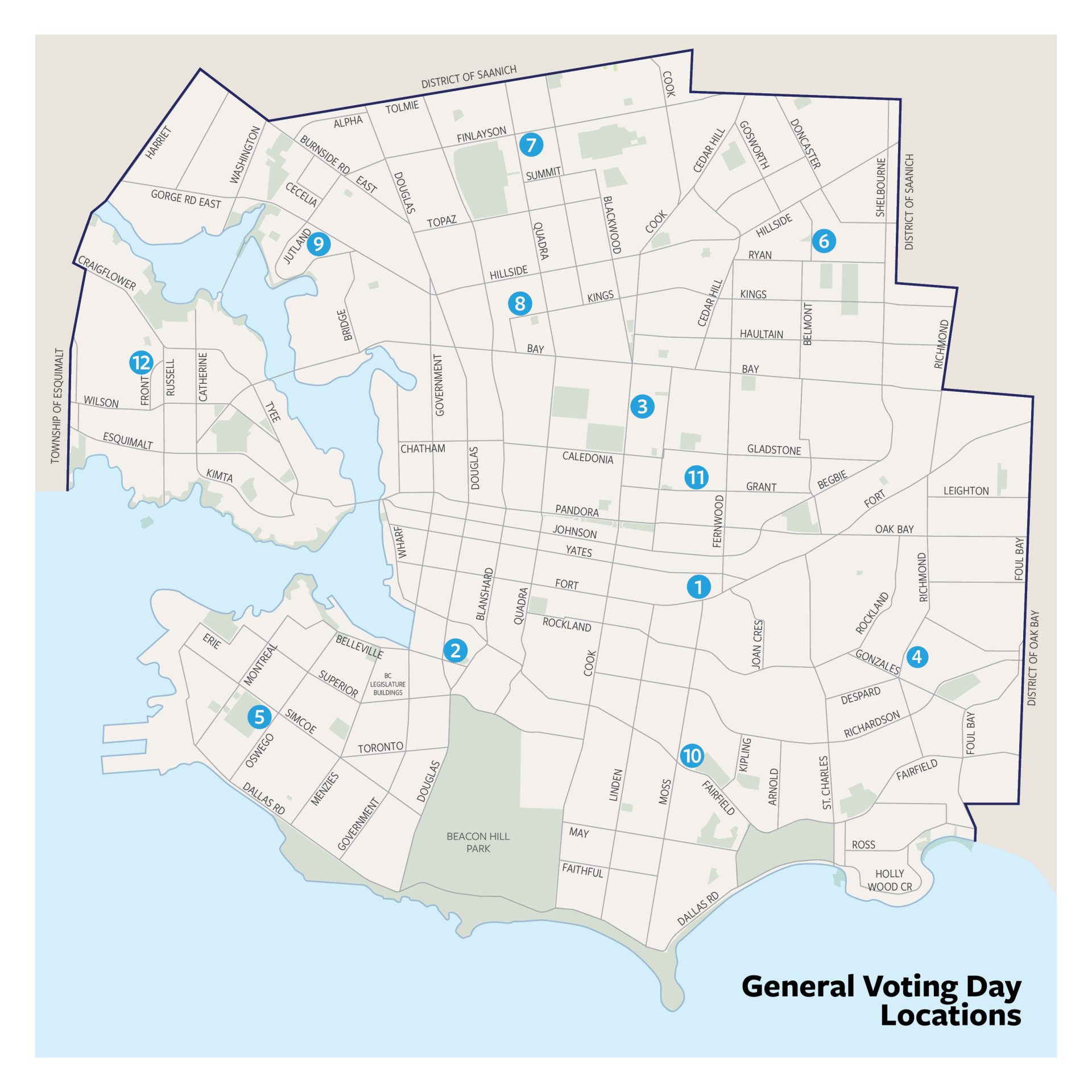
- Central Middle School, 1280 Fort St.
- Crystal Garden, 713 Douglas St.
- George Jay Elementary School, 1118 Princess Ave.
- Glenlyon Norfolk Senior School, 781 Richmond Ave.
- James Bay Community School, 140 Oswego St.
UPDATE (3 p.m.): An internet connectivity issue at James Bay Community School is slowing voter check-in and registration. While we work to fix the issue, a FREE BUS SERVICE is available to take voters to Crystal Garden to vote and then return to James Bay Community School. - Oaklands Elementary School, 2827 Belmont Ave.
- Quadra Elementary School, 3031 Quadra St.
- Quadra Village Neighbourhood Gym, 950 Kings Rd.
- Royal Canadian Legion Branch 292, 411 Gorge Rd. East
- Sir James Douglas Elementary School, 401 Moss St.
- Victoria High School, 1260 Grant St.
- Victoria West Elementary School, 750 Front St.
NOTE: If you recently placed your completed mail ballot in the mail and are concerned the City won’t receive it in time, please vote in person. Your vote will only be counted once in the system. If you have voted in person and then receive your ballot in the mail, please dispose of it.
If you requested a mail ballot and did not receive one:
You can request a replacement mail ballot by contacting the City at elections@victoria.ca or 250.361.0571:
- for pick up at City Hall on Oct. 15, 16 and 17, from 8 a.m. to 4:30 p.m.
- or for drop off to your home and return to City Hall from Oct.15 to 17 by 8 p.m.
While contacting us in advance helps reduce processing time, you can still come by City Hall to request and pick up your replacement mail ballot.
NOTE: City Hall will be open on Saturday, Oct. 17, from 8 a.m. to 4:30 p.m. to pick up replacement mail ballots.
For voters with accessibility needs, there are services available to help you vote.
- Voters who can’t enter a voting place, including parents and caregivers, can vote at the curb or in the parking lot.
- All voting locations are wheelchair accessible.
- A priority line is available for those who need it at all voting opportunities.
- An accessible voting machine is available at the Crystal Garden during advance voting and on General Voting Day.
- Assistance is available to voters unable to mark a ballot because of a physical disability or difficulty with reading or writing. Voters needing assistance to mark their ballot may bring another person, who will be required to sign a declaration, or ask an election official for assistance.
Victoria Election 2026
On Saturday, Oct. 17, 2026, Victoria voters had the opportunity to elect one mayor, eight councillors, three CRD directors and two School District 61 trustees in the City of Victoria's 2026 Local Government Election.
The ballot also included a non-binding question asking voters: Do you support Saanich and Victoria becoming one municipality?
In the 2018 municipal election, residents of Victoria and Saanich voted in favour of exploring the costs, benefits and disadvantages of amalgamation of the two municipalities through a citizens' assembly process.
In July 2025, the Victoria-Saanich Citizens' Assembly provided its recommendations for amalgamation to both municipalities.
Learn about the work of the Citizens’ Assembly and read their final report to understand why the assembly believes the two communities should amalgamate.
October 2014 - During the 2014 General Local Elections, both Victoria and Saanich conducted community opinion questions asking residents if they were in favour of exploring amalgamation or integration. In both municipalities, residents voted in favour of exploring these concepts further.
October 2018 - During the 2018 General Local Elections, both Victoria and Saanich residents were asked the following community opinion question: “Are you in favour of spending up to $250,000 for establishing a Citizens’ Assembly to explore the costs, benefits and disadvantages of the amalgamation between the District of Saanich and the City of Victoria?”
A majority of voters in both municipalities supported the proposal. Victoria, Saanich and the Province each contributed approximately $250,000 to undertake this work. The work was delayed by the COVID-19 pandemic.
2024-2025 – Work resumed in 2024 with the establishment of the Citizens’ Assembly, supported by MASS LBP and guided by a Terms of Reference approved by both Councils. The Citizens’ Assembly was composed of 48 randomly selected residents from Victoria and Saanich. It met for eight, full-day sessions between September 2024 and April 2025.
April 2025 - The Assembly concluded its deliberations on April 5, 2025, announcing its recommendation that the City of Victoria and the District of Saanich amalgamate into a single municipality.
July 2025 - The Citizens’ Assembly’s Final Report and findings were presented to Council. At the July 31, 2025 Daytime Council Meeting, Council passed the following resolution: “That Council receive the Victoria-Saanich Citizens’ Assembly – Final Report submission for information and direct staff to work with their counterparts in Saanich to craft a short question to be placed on the 2026 local election ballot in both municipalities, and to report back to Council with that question and any other information staff deem relevant, including whether the public needs more information in order to make an informed decision.”
October 2025 - The mayors of Victoria and Saanich jointly requested provincial authorization to hold a referendum in each municipality during the 2026 General Local Elections.
April 2026 – The Minister of Housing and Municipal Affairs informed the City and District of Saanich that a referendum would only be considered following additional analysis of the financial, transitional and service impacts of amalgamation, and consultation with area First Nations.
July 2026 – Victoria and Saanich Councils decide to move forward with the same non-binding question on their ballots: "Do you support Saanich and Victoria becoming one municipality?"
October 2026 – Local government elections are held across B.C. on Saturday, Oct. 17, 2026.
Information for Voters
Here's what you need to know to vote in the City of Victoria's 2026 Local Government Election.
Here is the Declaration of Election by Voting, which lists the candidates running for mayor and council in the City of Victoria's 2026 Local Government Election, in addition to those running for CRD director and School District 61 trustee.
Victoria voters may elect one mayor and up to eight councillors from the list of candidates on the ballot. Voters do not have to vote for everything noted on the ballot, for their vote to count.
To assist voters in finding information about candidates and making more informed choices, the City provides an online Candidate Profile Guide. All candidates were given the opportunity to submit a brief candidate profile and photograph to let voters know about themselves and their platforms. The content provided has not been edited in any way.
Eligible voters can vote at ANY of the following locations on General Voting Day on Saturday, Oct. 17 from 8 a.m. to 8 p.m.
Click on a location below to access its individual parking map.
- Central Middle School, 1280 Fort St.
- Crystal Garden, 713 Douglas St.*
- George Jay Elementary School, 1118 Princess Ave.
- Glenlyon Norfolk Senior School, 781 Richmond Ave.
- James Bay Community School, 140 Oswego St.
UPDATE (3 p.m.): An internet connectivity issue at James Bay Community School is slowing voter check-in and registration. While we work to fix the issue, a FREE BUS SERVICE is available to take voters to Crystal Garden to vote and then return to James Bay Community School. - Oaklands Elementary School, 2827 Belmont Ave.
- Quadra Elementary School, 3031 Quadra St.
- Quadra Village Neighbourhood Gym, 950 Kings Rd.
- Royal Canadian Legion Branch 292, 411 Gorge Rd. East
- Sir James Douglas Elementary School, 401 Moss St.
- Victoria High School, 1260 Grant St.
- Victoria West Elementary School, 750 Front St.
*An accessible voting machine will be available.
The opportunity to request a mail ballot has now passed. The deadline to request a mail ballot was 4 p.m. on Friday, Oct. 9.
If you have requested a mail ballot for pick-up, please allow two business days for a mail ballot request to be prepared before coming in to City Hall. Ballots for pick-up are available on weekdays from 8 a.m. to 4:30 p.m. at City Hall.
Oct. 13, 2026 UPDATE: The City has learned of a delay in Canada Post delivering requested mail ballots. Completed mail ballots must be received by the City by 8 p.m. on Saturday, Oct. 17, 2026, to be counted.
Mail Ballot Return:
- Do not place a completed mail ballot in the mail.
- Completed mail ballots can be returned:
- to the drop box at the Pandora Avenue entrance of City Hall by 8 p.m. on Saturday, Oct. 17.
- during an advance voting opportunity on Oct. 13, 14 and 15
- or by 8 p.m. at a voting place on General Voting Day on Saturday, Oct. 17
- If you’re not able to deliver your completed mail ballot in person, you can have someone drop it off on your behalf.
- When you visit a voting place to drop off a completed mail ballot, do not stand in line. Place it in the Mail Ballot Box or ask and Election Official for assistance.
- If you need us to pick up your completed mail ballot, email elections@victoria.ca or call 250.361.0571.
- NOTE: If you recently placed your completed mail ballot in the mail and are concerned the City won’t receive it in time, please vote in person. Your vote will only be counted once in the system. If you have voted in person and then receive your ballot in the mail, please dispose of it.
Request a Replacement Mail Ballot
If you requested a mail ballot and did not receive one:
- You can request a replacement mail ballot by contacting the City at elections@victoria.ca or 250.361.0571:
- for pick up at City Hall on Oct. 15, 16 and 17, from 8 a.m. to 4:30 p.m.
- or for drop off to your home and return to City Hall from Oct.15 to 17 by 8 p.m.
While contacting us in advance helps reduce processing time, you can still come by City Hall to request and pick up your replacement mail ballot.
NOTE: City Hall will be open on Saturday, Oct. 17, from 8 a.m. to 4:30 p.m. to pick up replacement mail ballots.
There will be five advance voting opportunities. All will be open from 8 a.m. to 8 p.m., except for the University of Victoria location which will be open from 10 a.m. to 4 p.m.
An accessible voting machine will be available at the Victoria Conference Centre and Crystal Garden.
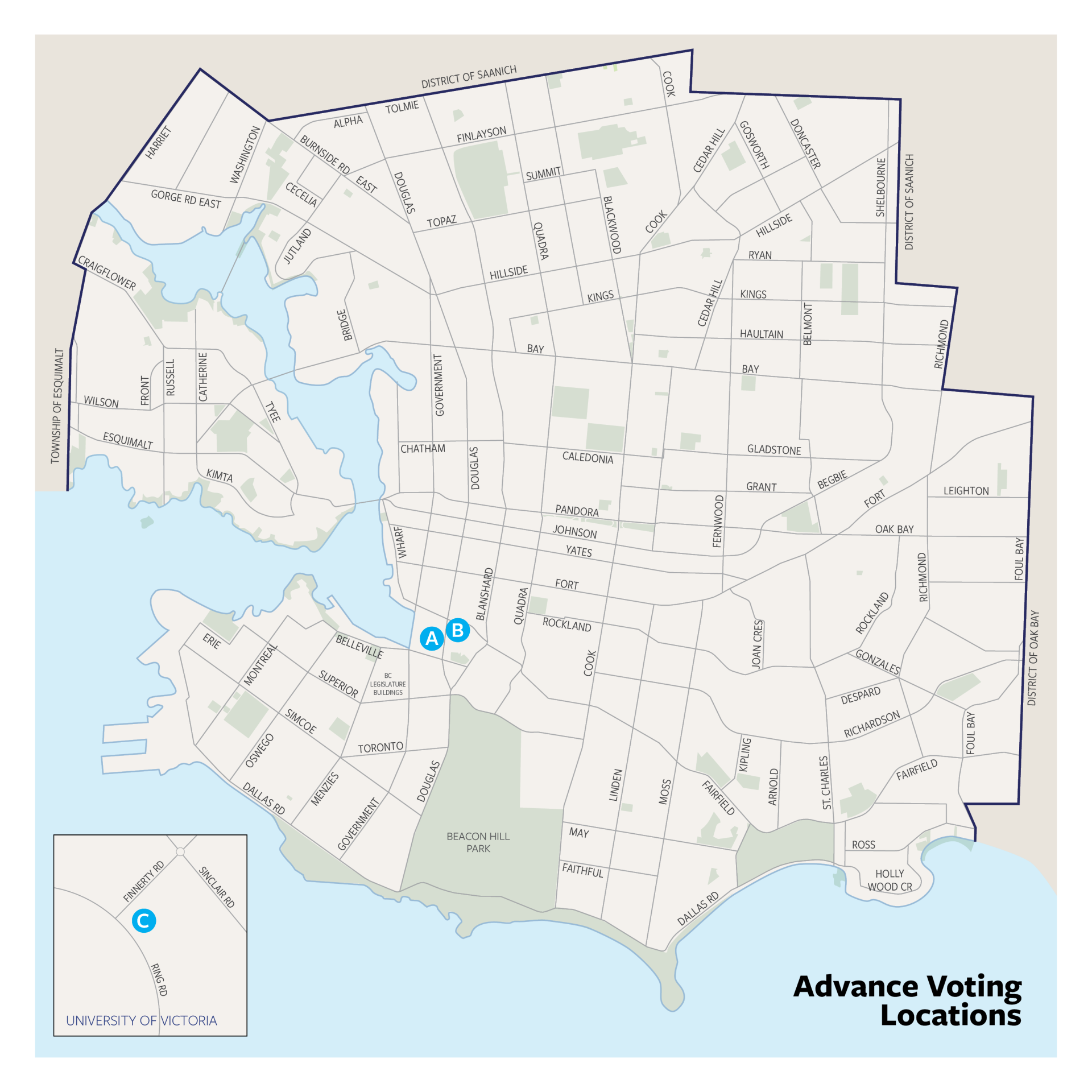
Click on a location below to access its individual parking map.
(A) Oct. 7: Victoria Conference Centre, Upper Pavilion, second floor, 720 Douglas St.
(B) Oct. 13: Crystal Garden, 713 Douglas St.
(B) Oct. 14: Crystal Garden, 713 Douglas St.
(C) Oct. 14: University of Victoria, Student Union Building, Michèle Pujol Room, 3800 Finnerty Rd.(10 a.m.-4 p.m.)
(B) Oct. 15: Crystal Garden, 713 Douglas St.
To vote in the City of Victoria's Local Government Election, you must:
- be a resident of the City of Victoria
- be a resident of British Columbia for at least six months before the day of registration
- be 18 years of age or older
- be a Canadian Citizen
- not be disqualified by law from voting
For voters with accessibility needs, we have services available to help you vote.
- A priority line for those who need it at all voting opportunities.
- All voting locations are wheelchair accessible.
- Voters who can’t enter a voting place, including parents and caregivers, can vote at the curb or in the parking lot.
- An accessible voting machine will be available at:
- Advance voting opportunities: Victoria Conference Centre, Upper Pavilion (Oct. 7) and Crystal Garden (Oct. 13, 14 and 15)
- General Voting Day on Oct. 17 at Crystal Garden
- Assistance is available to voters unable to mark a ballot because of a physical disability or difficulty with reading or writing. Voters needing assistance to mark their ballot may bring another person, who will be required to sign a declaration, or ask an election official for assistance.
Check to see if you're on the City's voters list.
If you're not on the voters list, please see How to Register to Vote below.
The City of Victoria uses the most current available provincial list of voters prepared by Elections BC. If you are listed on the provincial voters list, you should be on the City's voter list.
If you qualify as a resident elector but are not on the provincial voters list, you may register:
- when you vote at Advance Voting or at a General Voting Day voting place
- when you vote by mail
Two pieces of ID are required to register to vote, one of which must include your signature. Please see Identity Documents below to know what ID to bring.
The following are valid identity documents for proving voter identity.
- If you are a registered voter (on the voters list), you will need one piece of ID.
- If you are registering to vote at a voting place, you will be required to present at least two pieces of ID (one must have your signature).
The following are valid documents for proving voter identity:
- BC Driver’s Licence*
- Photo BC Services Card*
- Non-photo BC Services Card*
- BC Identification Card
- Certificate of Indian Status issued by the Government of Canada
- Student card issued by a post-secondary institution
- Owner’s Certificate of Insurance and Vehicle Licence issued by ICBC
- BC CareCard or BC Gold CareCard
- Ministry of Social Development and Economic Security Request for Continued Assistance Form
- Social Insurance Card
- Confirmation of Social Insurance Number letter issued by the Government of Canada
- Canadian Citizenship Card
- City of Victoria Property Tax Notice
- Statement of Employment Insurance Benefits
- BC Government cheque
- Income Tax Assessment Notice
- Canadian Forces Identification
- Old Age Security Identification Card
- Canadian Passport
- Birth Certificate
- Credit card or debit card or statement
- Utility bill issued for the supply of electricity, natural gas, water, telephone services or coaxial cable services
- A completed and signed Solemn Declaration that is witnessed and signed by a Commissioner of Affidavits in Form 12-16
*The dual BC Driver’s Licence and Services Card is one piece of ID.
Victoria property owners who live elsewhere in B.C. may be eligible to vote in the 2026 Local Government Election as a non-resident property elector. The owners must be individuals, not corporations.
Non-resident property electors must meet the following qualifications:
- age 18 or older on General Voting Day
- a Canadian citizen
- a resident of British Columbia for at least six months immediately before the day of registration
- a registered owner of real property in the City of Victoria for at least 30 days before the day of registration
- the only persons who are registered owners of the property, either as joint tenants or tenants in common, are individuals who are not holding the property in trust for a corporation or another trust
- not entitled to register as a resident elector
- not disqualified by any enactment from voting in an election or otherwise disqualified by law
- if there is more than one registered owner of the property, only one of those individuals may, with the written consent of the majority of the owners, register as a non-resident property elector
See How to Register as a Non-Resident Property Elector below.
If you are not on the voters list and qualify as a non-resident property elector, you may register in advance or at the time of voting.
To register as a non-resident property elector, you must provide:
- two pieces of identification:
- Both must show your full name
- One must include your address
- One must include your signature
- property title deed or current City of Victoria property tax notice
- a completed Application Form and;
- a completed Consent Form -- if the property is owned jointly with other individuals
Submit your documents to elections@victoria.ca.
For more information, call Legislative Services at 250.361.0571.
NOTE: You are ineligible to register as a non-resident property elector with corporate-owned properties. There is no corporate vote in BC.
Sign up now on the Future Voters List to be automatically registered to vote when you turn 18, if you're:
- 16 or 17 years old
- a resident of B.C.
- a Canadian citizen
Kids 12 and under are invited to enter the Victoria Election 2026 Kids Colouring Contest and have their artwork displayed at City Hall in December.
Three participants will be selected at random to serve as Mayor for the Day in early 2027 to learn more about how their local government works and enjoy complimentary lunch with the mayor.
Entries will be displayed so that no personal information is visible other than the child's first name, last initial and age.
Colouring Sheet
The 8.5" x 11" colouring sheet is available here for printing, and for pick-up at advance voting opportunities and voting places on General Voting Day, and at City Hall.
Entries to the colouring contest are due Friday, Nov. 27, 2026.
How to Submit
Submit completed colouring sheets to the Public Service Centre at City Hall on weekdays from 8 a.m. to 4:30 p.m. or mail to: Victoria Election 2026 Kids Colouring Contest, City of Victoria, 1 Centennial Square, Victoria, BC V8W 1P6.

Helpful Resources
Below are resources to help you vote in the City of Victoria's 2026 Local Government Election.
To assist voters in finding information about Victoria's candidates and making more informed choices, the City provides an online Candidate Profile Guide.
Candidates for Mayor and Council were given the opportunity to provide a brief profile and photograph to let voters know about themselves and their platforms.
The content provided has not been edited in any way.
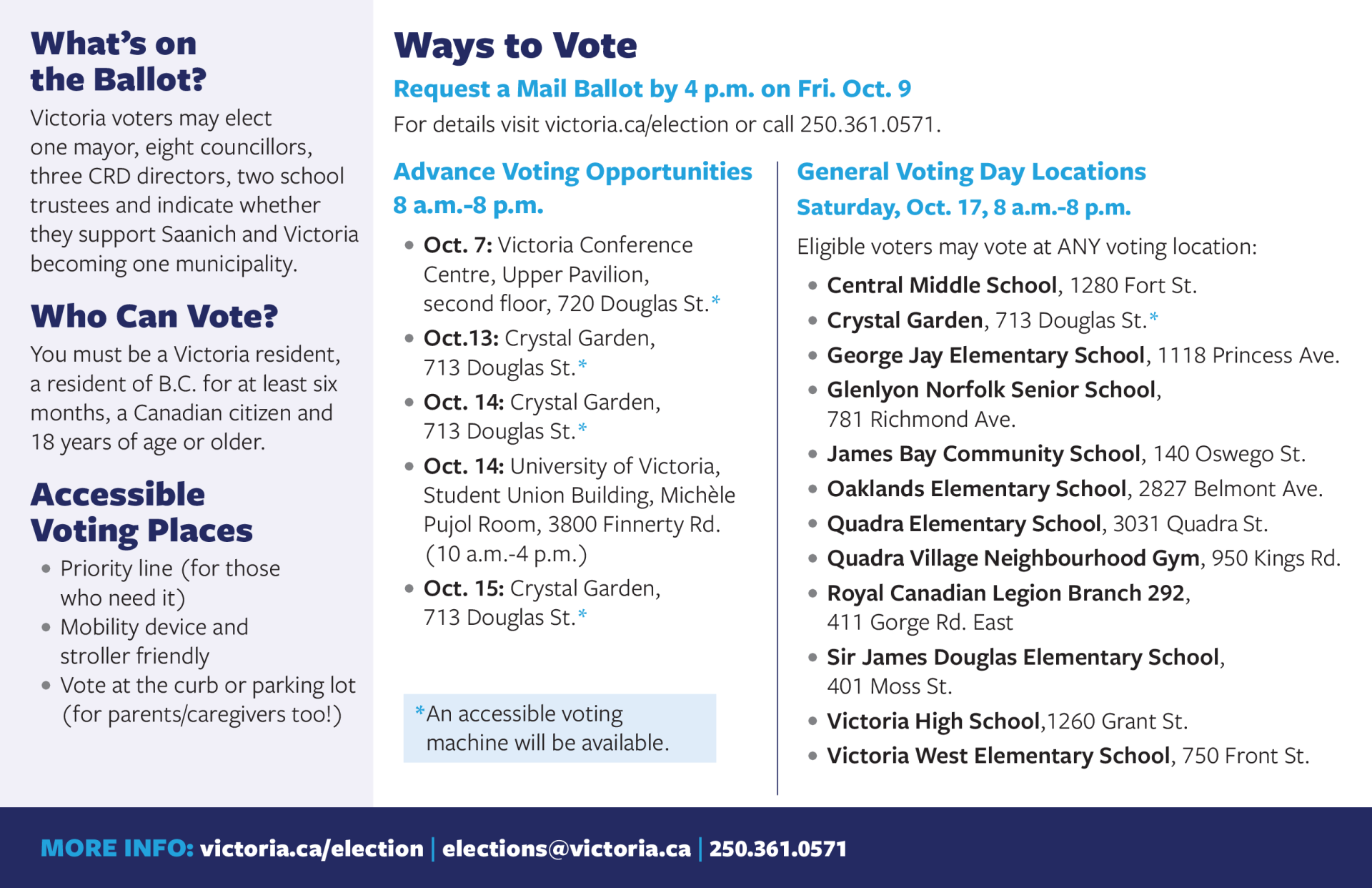
Victoria Election 2026 Postcard - Delivered by Canada Post to Victoria residents the week of Sept. 14-18, this postcard provides helpful information on the City's upcoming election.
(Note: Some Victoria postal walks extend across municipal boundaries. If you live in a municipality bordering the City of Victoria, and received this postcard, please recycle it.)
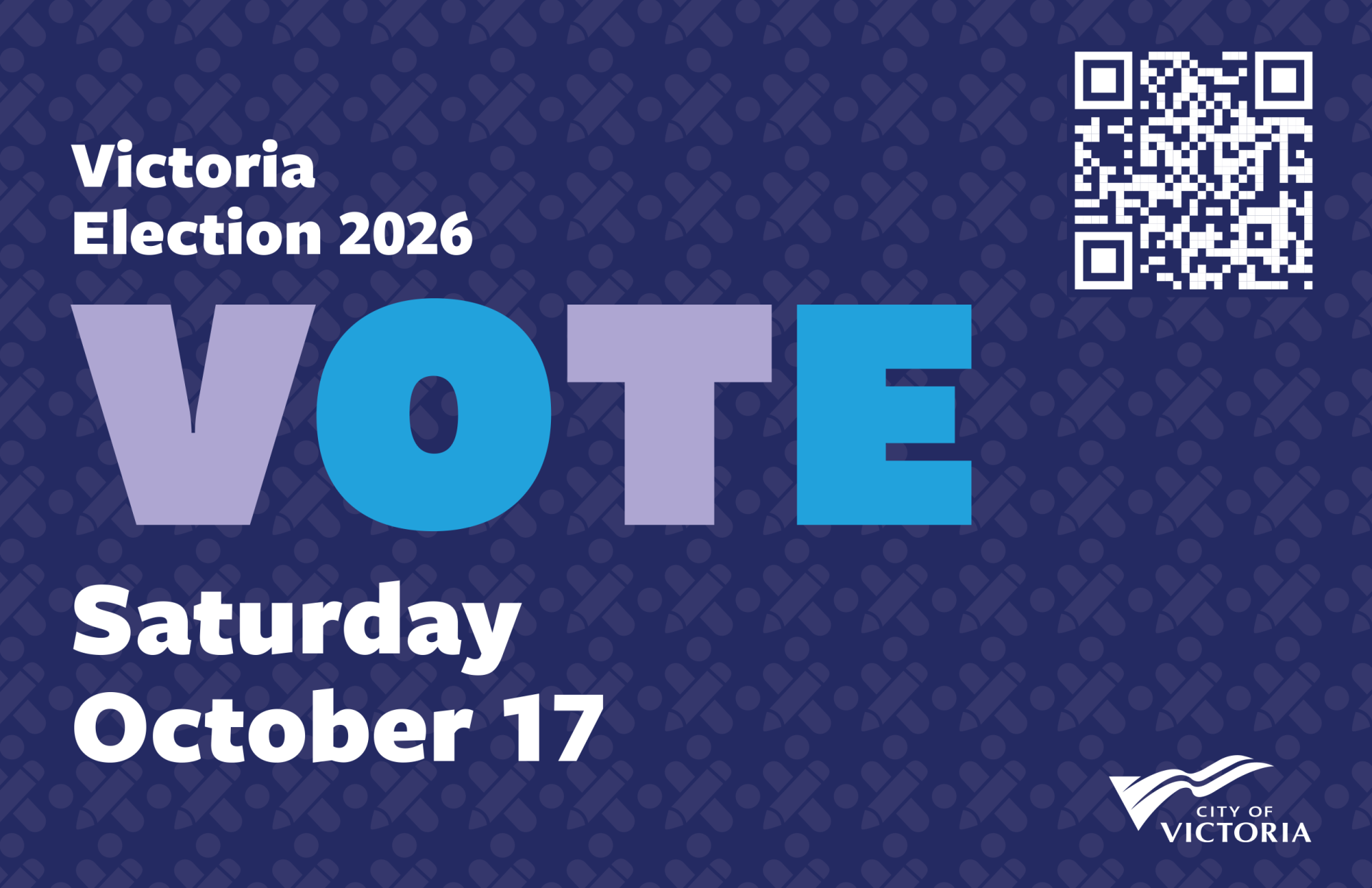
Special Election Issue of the Connect Newsletter - Delivered to Victoria residents the week of Sept. 21-25, this special issue of Connect includes everything voters need to know to vote, including a map of all advance and General Voting Day places and a list of acceptable ID.
(Note: Some Victoria postal walks extend across municipal boundaries. If you live in a municipality bordering the City of Victoria, and received this newsletter, please recycle it.)
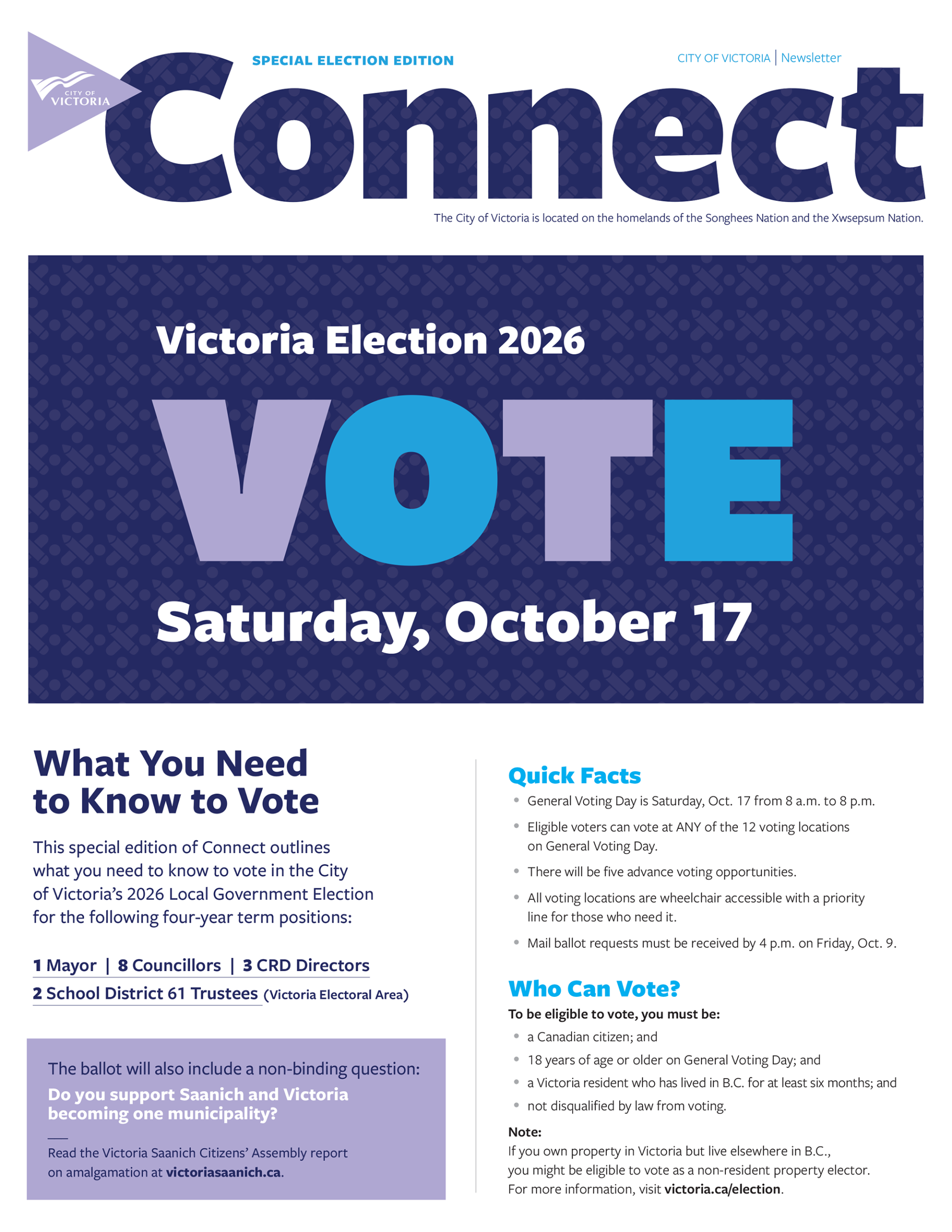
The information in the special election issue of the Connect newsletter is available in six languages below.
Victoria Election 2026 Info Sheet (Arabic)
Victoria Election 2026 Info Sheet (Cantonese)
Victoria Election 2026 Info Sheet (Mandarin)
Victoria Election 2026 Info Sheet (Punjabi)
Victoria Election 2026 Info Sheet (Spanish)
Victoria Election 2026 Info Sheet (Tagalog)
2026 Election Candidates
The Declaration of Election by Voting is now available. It lists all those running for mayor and council in the City of Victoria’s 2026 Local Government Election, along with candidates running for CRD director and School District 61 trustee.
There are eight candidates running for the position of mayor.
ALTO, Marianne
ATKINSON, Lyall
GERVAIS-HARRISON, Darren
HANNA, Christopher
HARRIS, Mike
JOHNSTON, David
MCGUIGAN, Bruce
MILLER, Gregoor
There are 21 candidates running for the position of Councillor on Victoria City Council.
BOWKETT, Wendy
CARADONNA, Jeremy
COLLINS, Herb
CSESZKO, Melissa
DELL, Matt
DION, Shona
FILIPOVIC, Steve
GARCIA, Jerry
GARDINER, Marg
GIBBS, Peter Rose
GIRARD, Martin
HAMMOND, Stephen
HARASYMOW, James
HEIT, Jason
KIM, Susan
LEE, Bella
LOUGHTON, Krista
MCINNIS, Arthur
ROTHE, Karen
SANDOR, Jack
THOMPSON, Dave
Information for Candidates
Below is helpful information for individuals who are running for City Council in the 2026 municipal election.
The Local Government Act and the City of Victoria’s Sign Bylaw set out requirements for the placement of campaign signs. Candidates may place campaign signs on public property from September 19 to October 21 subject to the requirements of the Sign Bylaw.
Campaign signs may only be placed on private property with the consent of the property owner. The Local Government Act prohibits the placement of election signs within 100 metres of a building where voting proceedings are being conducted.
NOTE: A campaign sign that does not comply with the Sign Bylaw may be removed. To see if your campaign sign has been removed and stored for four days, please contact City of Victoria Public Works at 250.361.0400.
Elections BC administers, investigates and enforces campaign financing, third-party sponsor and election advertising provisions under the Local Elections Campaign Financing Act.
Information can be found on the Elections BC website, including online learning modules regarding:
- Campaign Financing
- Electoral Organizations
- Third-Party Advertising
To run for a seat on Victoria City Council, candidates must be:
- a Canadian citizen
- 18 years of age or older on General Voting Day
- a resident of B.C. for at least six months before the day nomination papers are filed, and
- not be disqualified under the Local Government Act or any other enactment.
Note: You do not need to be a City of Victoria resident to run for Council.
To be nominated, a candidate must:
- Consent to the nomination
- Submit nomination documents
- Be nominated by at least 25 nominators (a nominator must be eligible to vote in Victoria as a resident elector or as a non-resident property elector)*
- Pay a $100 refundable deposit when submitting nomination documents (refunded when a candidate files their Financial Disclosure Statement after the election)
- Submit a Financial Disclosure Statement that identifies corporate and personal holdings (the statement is part of the nomination documents)
*An elector can act as a nominator for more than one candidate but must not nominate more candidates than there are positions to be filled during the election.
The nomination period opens Sept. 1, 2026 at 9 a.m. and closes on Sept. 11, 2026 at 4 p.m. Pacific Time.
The Chief Election Officer accepts nomination documents only during the nomination period.
The nomination documents contain the required forms, declarations and information needed for prospective candidates to complete the nomination process.
Prospective candidates are encouraged to carefully review all materials before submitting.
Nomination documents may only be submitted during the nomination period and must meet all legislative requirements.
The nomination period opens Sept. 1, 2026 at 9 a.m. and closes on Sept. 11, 2026 at 4 p.m. Pacific Time.
2026 Victoria Election Nomination Forms and Information
Prospective candidates are encouraged to review the Candidate Information Guide located within the nomination documents for additional information on eligibility, key dates, campaign requirements and the election process.
If you have questions regarding the nomination process, please contact the City’s Election Office at elections@victoria.ca or 250.361.0571.
Candidates can submit their nomination documents to the Chief Election Officer by:
- In person: Legislative Services at Victoria City Hall, weekdays from 8 a.m.-4:30 p.m. (Please use the Pandora Avenue or Centennial Square entrance.)
- Email: elections@victoria.ca
- Mail: Legislative Services, City of Victoria, 1 Centennial Square, Victoria, BC V8W 1P6
Appointments are strongly recommended for in-person visits.
Candidates can pay their nomination deposit:
- In-person at the Public Service Centre at Victoria City Hall, weekdays from 8 a.m.-4:30 p.m. Methods of payment include debit, cash, cheque and credit card.
- By e-transfer to accountsreceivable@victoria.ca, attention: Chief Election Officer
Note: Please include the payment receipt when submitting your nomination documents.
The Province of B.C. has additional information about running for local office.